Cogleap Summer Camp
Reframing a Consultation-Based Workflow into a Self-Serve Enrollment Experience
Overview
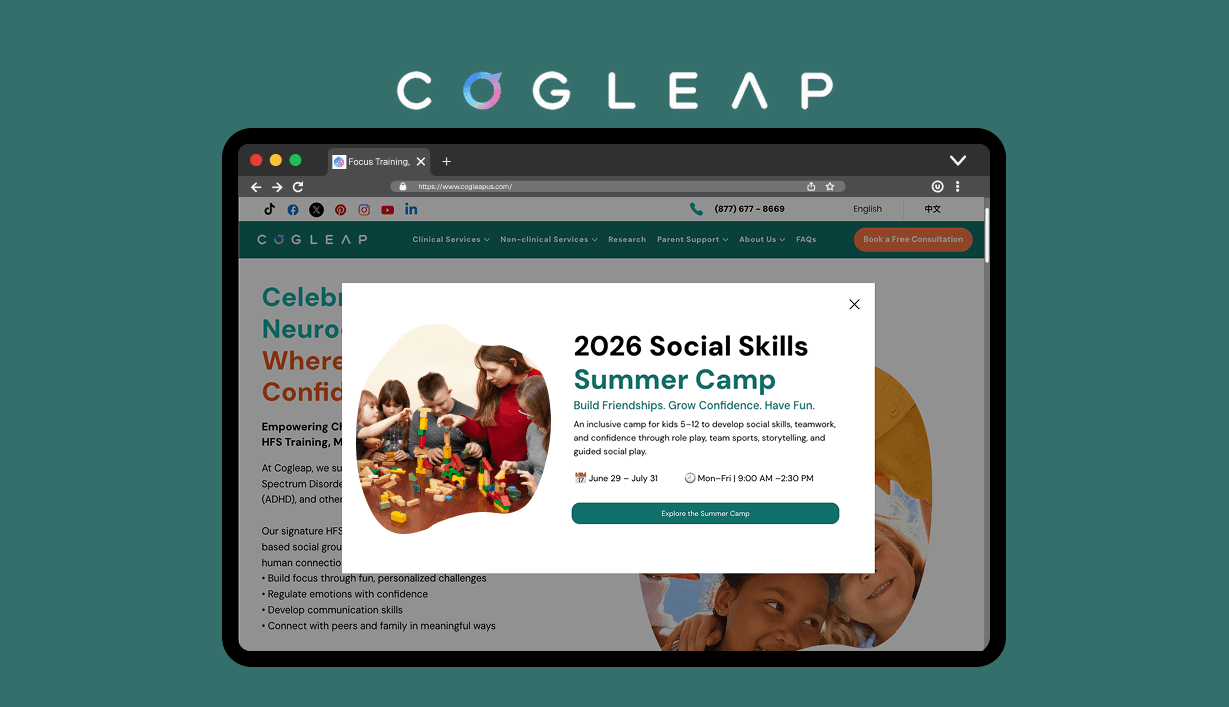
Led the end-to-end design of Cogleap’s Summer Camp enrollment experience, transforming a consultation-driven process into a scalable self-serve workflow that reduced friction, accelerated enrollment, and improved operational efficiency.
My Role
Solo Product Designer
Owned research, workflow design, stakeholder alignment, and delivery for the end-to-end enrollment experience.
Team
Gloria Yang (Me)
Cogleap Product Team
Timeline
20 hrs
April 2026
Context
Launching a Time-Sensitive Product Within a Consultation-Driven System
Cogleap is a digital health-focused organization whose existing platform was built around consultation-based services. For most clinical and long-term programs, users first submit an inquiry and wait for follow-up from a specialist before enrollment. This model supports personalized guidance, individualized assessment, and ongoing communication, which are important for healthcare-related services.
However, Summer Camp introduced a different type of user behavior and decision-making pattern. Unlike clinical services, parents visiting the Summer Camp page often arrived with high intent and expected a faster, more transactional enrollment experience.
The project was delivered within a one-week timeline and built entirely within Wix, requiring careful use of existing platform capabilities and design patterns while remaining clear, trustworthy, and compliant within a digital health environment.
Problem
A Workflow Designed for Clinical Services Created Friction for Summer Camp Enrollment
The initial plan was to reuse the existing consultation-based workflow by directing users to submit a request form and wait for specialist follow-up before registration and payment.
While this model worked for most their clinical services, it created friction for a time-sensitive enrollment product where users were often ready to act immediately. The delay between interest and enrollment introduced uncertainty around securing a spot, increased the likelihood of drop-off, and created unnecessary operational overhead for the team.
The challenge wasn’t that the consultation model was ineffective overall. It was that the workflow no longer aligned with the urgency, behavior, and decision-making patterns of Summer Camp enrollment.
🚧
Breaks User Momentum at the Point of Decision
⏳
Introduces Delay and Increases Drop-Off Risk
⚙️
Relies on Manual Work That Limits Scalability
What I Proposed
Designing a Self-Serve Enrollment Experience
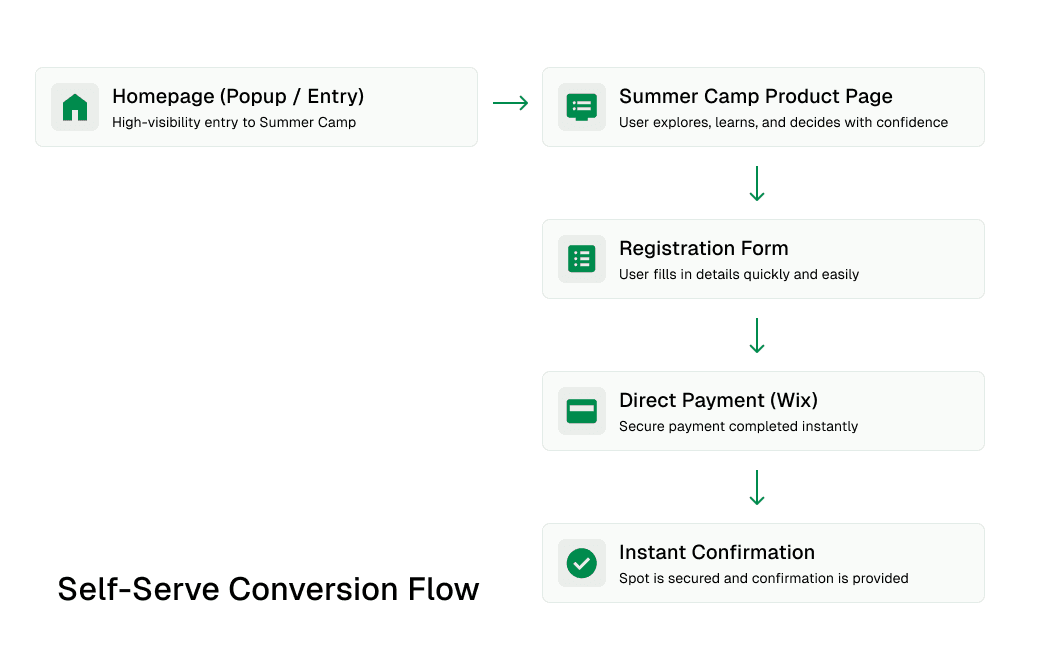
I proposed redesigning the experience as a dedicated self-serve enrollment funnel that allows parents to move directly from discovery to registration and payment without waiting for manual follow-up.
Instead of extending the existing consultation model, the new approach focused on reducing friction at the moment of decision and supporting immediate action. By leveraging built-in Wix capabilities, the solution could be implemented quickly while remaining scalable and operationally efficient.
This shifted the experience from a specialist-assisted service flow into a conversion-oriented enrollment journey aligned with how users naturally progress through decision-making.
Key Product Principles Driving the Solution
Reduce Dependency on Manual Intervention
Move from specialist-assisted onboarding to a scalable self-serve workflow that minimizes operational overhead.
Minimize Delay Between Intent and Action
Allow users to immediately register and secure a spot without waiting for follow-up communication.
Provide Immediate Confirmation to Build Confidence
Reduce uncertainty by confirming enrollment and payment instantly.
Support Continuous User Momentum
Create a smooth progression from:
explore → learn → decide → register → purchase
Stakeholder Influence
Aligning on a Different Enrollment Model
Stakeholders initially preferred reusing the existing consultation-based workflow because it aligned with current operational processes already used across Cogleap’s clinical services. The challenge wasn’t designing the enrollment flow itself. It was aligning on the idea that Summer Camp required a fundamentally different interaction model from the organization’s longer-term healthcare programs.
To ensure alignment, I reframed the discussion around user behavior, conversion risk, and operational scalability rather than design preference. I explained that consultation-based workflows made sense for personalized clinical services that required specialist guidance, but Summer Camp functioned more like a high-intent enrollment product where users expected immediate action and confirmation.
Stakeholders also shared that the previous process often required several days of back-and-forth communication before parents could successfully complete enrollment. This reinforced how extending the consultation model to a time-sensitive program introduced unnecessary friction for both users and staff. By shifting the conversation from maintaining operational consistency to supporting user momentum and scalability, we aligned on moving forward with a self-serve enrollment experience.
Key Alignment Shift
Clinical consultation workflow
Self-serve enrollment workflow
This clarity helped stakeholders recognize that the original model was optimized for specialist-assisted healthcare services, while the proposed approach better supported high-intent enrollment behavior, operational efficiency, and scalability.
Solution
Delivering a Seamless Enrollment Funnel
The final solution transformed the Summer Camp experience into a fully self-serve enrollment flow that supports immediate progression from exploration to registration and payment.
Each step was designed to reduce friction, maintain momentum, and reinforce confidence throughout the process. Parents could now seamlessly move through the journey without relying on manual coordination or delayed responses from staff.
The experience was fully implemented within Wix using existing platform capabilities, balancing usability improvements with technical and timeline constraints.
From Discovery to Registration

Designed a friction-reduced enrollment flow that allows parents to move directly from exploration to registration without relying on manual consultation or follow-up.
Completing Enrollment & Securing a Spot

Integrated Wix’s built-in checkout system to support immediate payment and confirmation, reducing delays and reinforcing user confidence at the point of decision.
Impact Overview
Reduced Enrollment Friction
Parents can now move from program discovery to registration and payment in a single continuous experience, eliminating delays caused by consultation-based onboarding.
Reduced Manual Coordination
Previously, staff often spent several days coordinating with parents through back-and-forth communication before enrollment could be completed. The self-serve workflow significantly reduced manual follow-up and operational overhead during enrollment periods.
Better Alignment Between Product and User Intent
The redesign shifted the experience from a high-touch clinical workflow to a conversion-driven enrollment model better suited for a time-sensitive program where users often arrive ready to act.
Delivered Within Real-World Constraints
Successfully launched the end-to-end enrollment experience within one week using existing Wix infrastructure and compliance limitations.
Reflection
Designing the Right Workflow, Not Just the Right Interface
This project reinforced that improving UX is not only about designing better interfaces, but identifying when an existing operational model no longer aligns with user behavior or product context.
The biggest challenge wasn’t building the enrollment flow itself. It was helping stakeholders recognize that different products require different interaction models. By grounding decisions in user intent, operational realities, and scalability, we were able to shift the experience from a delayed service workflow into a faster, conversion-driven system that better supports both users and the business.